
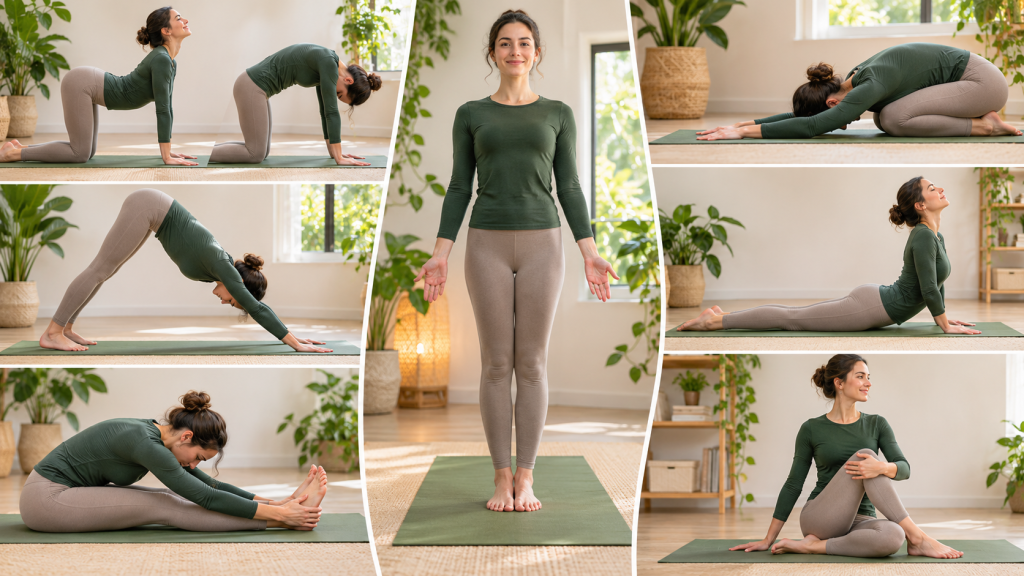
Starting yoga can feel a little confusing when you’re new to it.
You might have seen people moving effortlessly between poses, balancing on one leg, or stretching in ways that seem impossible. It’s easy to wonder whether you need to be flexible, fit, or experienced before you begin.
The good news is that yoga doesn’t have to look like that.
Yoga for beginners at home can start with a few comfortable movements, steady breathing, and enough space to move safely. You don’t need expensive workout clothes, advanced flexibility, or a perfect routine.
A short practice can give you an opportunity to move your body, notice how you’re feeling, and take a break from a busy day.
In this guide, we’ll explore 10 approachable yoga poses, simple modifications, a realistic 15-minute routine, and practical ways to make yoga part of your week.
The goal isn’t to master every pose. It’s to find movements that feel appropriate for your body and build confidence as you practice.
Table of Contents
What Is Yoga, and Why Do People Practice It?
Yoga is a practice that commonly combines physical postures, controlled breathing, and focused attention. Different forms of yoga may emphasize movement, relaxation, strength, flexibility, or meditation.
Some classes move quickly between positions. Others spend more time on slower movements and comfortable holds.
For beginners, a gentle, unhurried approach is often a practical place to start.
According to the National Center for Complementary and Integrative Health (NCCIH), research suggests yoga may help support certain aspects of well-being, including stress management, balance, and sleep.
The evidence varies depending on the outcome studied, and yoga isn’t a treatment for every health concern.
Do You Need to Be Flexible to Start Yoga?
No. You don’t need to touch your toes or perform complicated poses to begin.
Different people have different levels of mobility, balance, strength, and comfort. Your movements may look different from someone else’s, and that’s completely fine.
Instead of trying to reach a specific shape, focus on moving within a comfortable range.
For example, bending your knees during a forward fold is a useful adjustment, not a mistake.
Can a Short Yoga Routine Be Worthwhile?
Yes. A brief session can be a manageable way to introduce movement and relaxation into your day.
Fifteen minutes won’t automatically satisfy all your physical activity needs, but it can help you get started.
The CDC’s physical activity guidance for adults recommends a combination of aerobic exercise and muscle-strengthening activities throughout the week.
Depending on the style and intensity, yoga may contribute to certain aspects of fitness, but a gentle yoga session isn’t necessarily a replacement for brisk walking or a complete strength-training routine.
Think of yoga as one useful part of an active lifestyle.
What You Need Before Starting Yoga at Home
One of the appealing things about beginner yoga is that the setup can be simple.
You don’t need a dedicated room or a collection of specialized equipment.
Choose a Safe, Comfortable Space
Look for a quiet area with enough space to stand, sit, and stretch your arms.
Move small furniture, electrical cords, loose rugs, and other tripping hazards out of the way.
A nonslip yoga mat can provide cushioning and traction, but you can begin with a stable, nonslip surface for standing movements. Avoid slippery floors and unstable bedding.
Keep a sturdy chair or stable countertop nearby if you need balance support.
Wear Clothes That Let You Move
Choose comfortable clothing that allows you to bend and stretch without restriction.
Avoid anything that gets caught under your hands or feet.
You can practice barefoot on a suitable nonslip surface if comfortable, or use appropriate footwear when recommended for your needs.
Start With Comfortable Breathing
Before moving, pause and take a few relaxed breaths.
There’s no need to force unusually deep breathing or hold your breath.
Let your breathing remain natural and comfortable as you move.
Know When to Modify or Stop
Yoga should not involve pushing through sharp pain, dizziness, or concerning discomfort.
Stop if a pose causes pain or makes you feel unwell.
Seek urgent medical assistance for symptoms such as chest pain, fainting, or severe breathing difficulty.
If you have an injury, significant balance problems, glaucoma, uncontrolled blood pressure, a spinal condition, or another health concern, ask a qualified healthcare professional or trained instructor about suitable modifications.
Pregnant readers should seek pregnancy-specific guidance and avoid hot yoga or positions their healthcare professional advises against.
NCCIH recommends qualified instruction for beginners because learning yoga entirely without supervision can increase injury risk.
10 Easy Yoga Poses for Beginners at Home
These poses introduce several basic movement patterns: standing tall, gently bending, moving your spine, supporting your body, and resting.
You don’t have to complete all ten poses in every session.
For your first practice, move slowly and choose variations that feel appropriate for your abilities.
1. Mountain Pose (Tadasana)
Mountain Pose may look like ordinary standing, but it’s an opportunity to practice comfortable posture, balance, and body awareness.
How to do it:
- Stand with your feet about hip-width apart, or at another comfortable distance.
- Keep your weight balanced between both feet.
- Let your arms rest beside your body.
- Relax your shoulders without forcing them backward.
- Look forward and breathe naturally.
Suggested duration: 30–45 seconds.
What to notice: How your feet connect with the floor and how your body feels when you’re standing comfortably.
Beginner modification: Stand near a wall or hold a sturdy countertop if balance is difficult.
Common mistake: Locking your knees or pulling your shoulders into an uncomfortable position.
There is no need to stand perfectly straight or rigidly. Aim for a relaxed, steady posture.
2. Standing Side Stretch
This gentle movement helps you explore comfortable movement along the sides of your body.
How to do it:
- Begin in Mountain Pose with your feet stable.
- Raise one arm overhead only as high as feels comfortable.
- Slowly lean a small distance toward the opposite side.
- Keep both feet on the floor.
- Return to the center and switch sides.
Suggested duration: 20–30 seconds per side.
What to notice: A gentle stretching sensation along your side, without pressure or pain.
Beginner modification: Keep the raised hand on your hip instead of extending it overhead.
Common mistake: Leaning so far that you lose balance or strain your lower back.
You don’t need a deep bend. A small movement is enough to explore your range comfortably.
3. Chair Pose (Utkatasana) — Gentle Version
Chair Pose is a standing movement that can challenge your legs and help you practice bending at the hips and knees.
How to do it:
- Stand with your feet comfortably apart.
- Bend your knees slightly.
- Move your hips backward as though you’re beginning to sit in a chair.
- Extend your arms forward if comfortable, or keep your hands on your hips.
- Return to standing slowly.
Suggested duration: Hold for approximately 10–20 seconds, then stand and rest. Repeat once if comfortable.
What to notice: Your thighs and hips doing some of the work.
Beginner modification: Stand in front of a sturdy chair and lower yourself only a small distance, using support if needed.
Common mistake: Bending deeply despite knee discomfort or trying to hold the position too long.
Avoid forcing your knees or lower back into painful positions.
4. Standing Forward Fold (Uttanasana) — Bent-Knee Version
Forward folds can help you explore gentle movement through your hips and the backs of your legs.
For beginners, keeping your knees bent is usually more comfortable than trying to straighten your legs fully.
How to do it:
- Stand with your feet hip-width apart.
- Soften your knees.
- Slowly hinge forward from your hips.
- Rest your hands on your thighs or a stable support.
- Allow your head and neck to remain comfortable.
- Return to standing slowly, using your legs for support.
Suggested duration: 15–25 seconds.
What to notice: Gentle movement rather than a goal of touching your toes.
Beginner modification: Place your hands on a stable countertop and make a smaller forward bend.
Common mistake: Locking your knees, bouncing, or rounding your body aggressively to reach the floor.
If bending forward causes dizziness, reflux discomfort, or back pain, skip this pose or use professional guidance.
5. Cat-Cow Pose (Marjaryasana–Bitilasana)
Cat-Cow is a gentle sequence that alternates between two comfortable spinal movements.
You can perform it on your hands and knees or use a seated version.
How to do it:
- Begin on your hands and knees on a supportive mat.
- Keep your hands roughly beneath your shoulders and knees beneath your hips.
- As you breathe in comfortably, gently allow your chest to move forward and your back to arch slightly.
- As you breathe out, gently round your back.
- Continue slowly without forcing either position.
Suggested duration: 45–60 seconds, or approximately 5–8 slow movements.
What to notice: Your back moving gradually between two positions.
Beginner modification: Sit upright in a sturdy chair, place your hands on your thighs, and gently alternate between rounding and lengthening your back.
Common mistake: Dropping your head sharply backward or exaggerating the movement in your lower back.
Cleveland Clinic provides additional Cat-Cow instructions and technique guidance.
6. Child’s Pose (Balasana) — Supported Version
Child’s Pose is commonly used as a resting position during yoga.
However, it isn’t comfortable for everyone, particularly people with knee, hip, or ankle limitations.
How to do it:
- Begin on your hands and knees on a comfortable mat.
- Slowly move your hips backward toward your heels, only as far as comfortable.
- Allow your arms to extend forward or rest beside you.
- Support your upper body with a cushion if needed.
- Breathe normally and return to a comfortable position when ready.
Suggested duration: 30–45 seconds.
What to notice: A resting position rather than a demanding stretch.
Beginner modification: Sit on a sturdy chair with your feet on the floor, and gently lean forward from your hips while resting your arms on your thighs or a table.
Common mistake: Forcing your hips toward your heels despite knee or ankle pain.
If the floor version is uncomfortable, the chair variation is a reasonable alternative.
7. Tabletop Pose (Bharmanasana)
Tabletop Pose is a basic hands-and-knees position used in many yoga sequences.
It helps you become familiar with supporting your body and maintaining a comfortable, steady posture.
How to do it:
- Place your hands and knees on a mat.
- Position your hands roughly beneath your shoulders.
- Keep your knees beneath your hips.
- Look toward the floor while keeping your neck relaxed.
- Breathe normally and maintain a comfortable position.
Suggested duration: 20–30 seconds.
What to notice: Gentle muscular effort in your arms and trunk.
Beginner modification: Place your hands on a sturdy countertop instead, maintaining a comfortable incline.
8. Seated Forward Bend (Gentle Version)
A gentle seated forward bend can help you explore comfortable movement through the hips and back of the legs. You don’t need to touch your toes or push your body into a deep stretch.
How to do it:
- Sit on a yoga mat with your legs extended comfortably in front of you.
- Bend your knees slightly if keeping your legs straight feels uncomfortable.
- Sit upright and relax your shoulders.
- Slowly lean forward from your hips, keeping your spine at a comfortable angle.
- Rest your hands on your thighs or lower legs without pulling yourself forward.
- Breathe naturally for 15–30 seconds, then slowly return upright.
Beginner benefit: Encourages awareness of hip movement and provides a gentle stretch through the backs of the legs.
Common mistake: Rounding your back forcefully or pulling on your feet to reach farther.
Beginner modification: Sit on a folded blanket to make it easier to remain upright. Keep your knees bent and move forward only as far as feels comfortable.
Safety tip: Avoid deep forward bending if it causes back pain, tingling, or discomfort. People with certain spinal conditions may need a different movement.
Remember that flexibility develops differently for everyone. Reaching your toes is not a requirement for practicing yoga.
9. Knees-to-Chest Pose (Apanasana)
Knees-to-chest is a gentle floor-based movement often included near the end of a yoga session.
It gives you an opportunity to relax and explore comfortable movement around your hips and lower back.
How to do it:
- Lie on your back on a comfortable yoga mat.
- Bend your knees and place both feet flat on the floor.
- Slowly bring one knee toward your chest.
- Hold the back of your thigh or shin gently, without pulling forcefully.
- Breathe comfortably for 15–20 seconds.
- Lower that foot and repeat with the other leg.
- If comfortable, you may bring both knees toward your chest for a few breaths.
Beginner benefit: Offers a gentle way to relax on the floor and move your hips through a comfortable range.
Common mistake: Pulling the knees too tightly or lifting your head and shoulders unnecessarily.
Beginner modification: Keep one foot on the floor while bringing the opposite knee toward your chest.
Safety tip: Skip any variation that causes discomfort in your hips, back, abdomen, or knees. If getting onto or off the floor is difficult, choose a comfortable seated movement instead.
You don’t need to pull your knees as close as possible. A smaller movement can be enough.
10. Corpse Pose (Savasana)
Savasana is commonly used at the end of a yoga session.
Despite its unusual name, the pose is simple: you rest comfortably while allowing your body to settle after movement.
For many beginners, it can also be an opportunity to practice paying attention to their breathing without trying to control every breath.
How to do it:
- Lie comfortably on your back on a yoga mat.
- Extend your legs naturally, allowing your feet to relax.
- Rest your arms beside your body with your hands in a comfortable position.
- Relax your shoulders, jaw, and facial muscles.
- Breathe normally without forcing long or deep breaths.
- Remain in the position for one to three minutes, or as long as feels comfortable.
- When ready, roll gently onto your side before returning to a seated position.
Beginner benefit: Provides a quiet transition from movement back to everyday activity.
Common mistake: Trying so hard to relax that the pose becomes another task to complete.
Beginner modification: Place a pillow beneath your knees if that makes your lower back more comfortable. You can also rest in a supported seated position instead of lying flat.
Safety tip: If lying on your back causes dizziness, breathing difficulty, or discomfort, change position. During pregnancy, seek individualized advice about comfortable resting positions.
You don’t have to empty your mind. Simply notice your breathing and let yourself rest.
A Simple 15-Minute Yoga Routine for Beginners at Home
Once you’re familiar with the poses, you can combine a few into a short home practice.
This sample routine is intended for beginners who want a manageable introduction to yoga.
It isn’t necessary to complete all ten poses in every session. The aim is to move gently, learn comfortable positions, and finish feeling settled rather than exhausted.
Minutes 0–2: Arrive and Warm Up
Begin in a comfortable seated or standing position.
Take a few normal, relaxed breaths. Slowly move your shoulders, gently turn your head within a comfortable range, and loosen your arms.
You can also march lightly in place or walk around your room for a minute.
Avoid sudden stretches or forceful breathing.
Minutes 2–5: Practice Gentle Standing Movements
Choose two or three comfortable standing poses from the first seven poses in this guide.
Move slowly as you enter and leave each position.
Use a stable wall or countertop for support when needed.
Keep your knees relaxed, avoid locking your joints, and maintain a comfortable breathing rhythm.
Spend roughly one minute on each selected movement, including transitions.
If balance feels uncertain, choose supported variations rather than attempting to hold a difficult position.
Minutes 5–8: Continue With Comfortable Movement
Select two or three additional poses from the earlier part of the article.
Focus on controlled movement and comfortable alignment rather than achieving the deepest stretch.
If a pose feels too demanding, return to an easier variation or skip it entirely.
Leave enough time between movements to adjust your position safely.
Minutes 8–10: Seated Forward Bend
Sit comfortably on your mat.
Try the gentle seated forward bend described in Pose #8.
Keep your knees slightly bent, breathe normally, and avoid forcing your upper body toward your legs.
You may hold the position briefly, return upright, and repeat if comfortable.
Use the remaining time to transition slowly onto your back.
Minutes 10–12: Knees-to-Chest Pose
Practice the single-leg knees-to-chest variation from Pose #9.
Bring one knee toward your chest gently, pause for a few breaths, and switch sides.
Avoid pulling, bouncing, or pressing into pain.
If floor exercises aren’t suitable for you, use this period for a comfortable seated relaxation exercise instead.
Minutes 12–15: Savasana and Relaxation
Finish with Savasana, Pose #10.
Rest in a position that feels comfortable.
Allow your shoulders and legs to relax while breathing naturally.
When the three minutes are over, move slowly as you return to sitting or standing.
There is no need to jump up immediately.
Important: This 15-minute routine is an example, not a medical or therapeutic program. Adjust the duration or leave out movements that don’t suit your abilities.
How Often Should Beginners Practice Yoga?
There’s no single schedule that works for everyone.
Some beginners enjoy a short practice several days a week, while others prefer one or two sessions to become familiar with the movements.
A practical approach is to start with two or three short sessions per week, provided the movements are appropriate for you.
As your confidence grows, you can adjust the frequency or duration.
Consistency matters, but it shouldn’t come at the expense of comfort or recovery.
Start With Short Sessions
If 15 minutes feels too long, start with five minutes.
Practice one or two comfortable poses, followed by a short relaxation period.
You can gradually spend more time practicing as you learn what works for your body.
Allow Time for Recovery
Gentle yoga may feel comfortable on many days, but more demanding movements can cause fatigue or soreness.
Pay attention to how you feel afterward.
If you’re unusually sore or tired, choose rest or lighter movement rather than pushing through.
Combine Yoga With Other Activities
Yoga can be one part of an overall movement routine.
Walking, strength training, and other enjoyable activities offer additional ways to support physical health.
The CDC’s physical activity guidelines recommend that adults aim for at least 150 minutes of moderate-intensity aerobic activity per week and muscle-strengthening activity on at least two days.
A gentle yoga session does not necessarily count as moderate-intensity aerobic exercise, and not every yoga practice provides sufficient resistance for comprehensive strength training.
If you enjoy variety, explore our 15-Minute Walking Routine for Beginners and Beginner Strength Training at Home guides.
Common Yoga Mistakes Beginners Should Avoid
Starting yoga at home is convenient, but learning without an instructor means it’s especially important to approach movements carefully.
The National Center for Complementary and Integrative Health (NCCIH) explains that yoga is generally considered safe for healthy people when practiced appropriately, although injuries can occur.
You can read more in its Yoga: Effectiveness and Safety guidance.
Trying to Copy Advanced Poses
Online yoga videos can make difficult positions appear effortless.
But a pose performed by someone with years of experience may not be suitable for someone just starting.
Begin with simple positions and focus on comfort.
Avoid challenging inversions, such as headstands or shoulder stands, without appropriate qualified instruction.
Stretching Through Pain
A mild stretching sensation can be normal, but sharp pain or joint discomfort is not something to ignore.
Don’t force your body into a position to make it look like a picture.
Instead, reduce your range of motion, use a modification, or skip the pose.
Holding Your Breath
Beginners sometimes hold their breath while concentrating on balance or stretching.
Try to breathe naturally and comfortably throughout each movement.
There’s no need to force deep breathing or practice breath-holding techniques.
Moving Too Quickly Between Poses
Rushing can make it difficult to maintain balance or notice discomfort.
Take your time when changing positions, especially when moving between standing and floor exercises.
Using a stable support can help when balance is challenging.
Practicing on an Unsafe Surface
A slippery floor, loose rug, or cluttered room can increase the chance of falling.
Choose a stable, clear surface with enough space to move your arms and legs.
If you use a yoga mat, make sure it stays securely in place.
Expecting Immediate Results
Yoga isn’t a competition or a guaranteed solution to every health concern.
You might gradually become more comfortable with certain movements or enjoy the quiet time in your routine.
Focus on how the practice fits your life rather than expecting dramatic changes after a few sessions.
How to Make Yoga a Consistent Part of Your Routine
One of the most useful things about yoga at home is that you can adapt the practice to your schedule.
You don’t need to reserve a full hour or purchase special clothing.
Choose a Realistic Time
Some people prefer yoga in the morning, while others enjoy a short session after work.
Neither time is automatically better.
Choose a time when you can move comfortably without rushing.
Keep Your Practice Space Simple
A clear area of your living room or bedroom may be enough.
Having your mat or another suitable surface ready can make it easier to begin.
Repeat Familiar Movements
You don’t need a completely new routine every day.
Repeating a few comfortable poses can help you become more confident with their movements.
As you learn, you can gradually explore other beginner-friendly variations.
Notice What Feels Comfortable
Pay attention to how your body responds.
Some poses may feel relaxing, while others might feel awkward or difficult.
Adjust your practice rather than assuming every pose must work for everyone.
Build Yoga Into a Broader Healthy Routine
Physical activity is only one part of everyday well-being.
Balanced meals, adequate sleep, and manageable habits can also contribute to a healthy lifestyle.
For more ideas, read our 7 Simple Healthy Habits You Can Start Today article.
Frequently Asked Questions About Yoga for Beginners at Home
Can I Start Yoga at Home Without Previous Experience?
Yes, many people begin with simple yoga movements at home.
However, proper instruction matters, and learning entirely on your own can make it harder to recognize mistakes.
Consider using beginner-level instruction from a qualified yoga teacher, especially if you’re unfamiliar with the movements.
Start with comfortable poses, avoid advanced positions, and stop if something causes pain.
Do I Need a Yoga Mat to Begin?
A yoga mat can provide comfort and traction, but expensive equipment isn’t necessary.
The most important thing is having a safe, stable, non-slip surface.
Avoid loose rugs or slippery flooring.
You may also find a firm cushion or folded blanket useful for supported seated positions.
Is 15 Minutes of Yoga Enough for Beginners?
Fifteen minutes can be a practical starting duration.
A short session gives you time to practice several gentle movements and finish with relaxation.
It isn’t necessary to perform every pose during one session.
For broader fitness, consider combining yoga with other appropriate physical activities.
Should I Practice Yoga Every Day?
You don’t have to practice daily to begin building a routine.
Some people enjoy gentle movement most days, while others prefer several sessions per week.
The appropriate frequency depends on the style of yoga, intensity, health, and how your body responds.
Rest when needed, and avoid repeatedly performing movements that cause pain.
Can Yoga Help With Stress?
Some research suggests yoga may help with stress management and general well-being.
However, individual results vary, and yoga should not replace professional treatment for significant or persistent mental health concerns.
A short, comfortable practice may provide an opportunity to focus on movement and breathing without everyday distractions.
Can Beginners Do Yoga if They Are Not Flexible?
Yes. You do not need exceptional flexibility to start.
Beginner-friendly modifications allow you to explore movements within your current comfortable range.
Flexibility varies from person to person, and it isn’t necessary to push into deep stretches.
Is Yoga Safe for Older Adults?
Yoga may be suitable for some older adults, particularly when movements are adapted to their abilities.
However, balance limitations, joint conditions, and other health concerns may require additional precautions.
Chair-based or supported yoga may be preferable for some people.
Qualified instruction and individualized medical guidance can help identify appropriate movements.
Can I Practice Yoga During Pregnancy?
Some modified forms of yoga may be appropriate during pregnancy, but not every pose or breathing practice is suitable.
Pregnancy can change balance, comfort, and exercise considerations.
Consult your prenatal healthcare professional and seek guidance from an appropriately qualified prenatal yoga instructor before starting or changing your routine.
Avoid assuming that a general beginner yoga sequence is automatically appropriate during pregnancy.
Final Thoughts: Start Yoga at Your Own Pace
Yoga doesn’t need to be complicated.
For a beginner, a few gentle poses and a short period of comfortable movement can be a useful way to explore a new activity.
You don’t need perfect flexibility, expensive equipment, or the ability to perform challenging positions.
Start with movements that feel manageable, practice them with care, and allow yourself time to learn.
If a pose doesn’t suit your body, choose an alternative rather than forcing it.
The aim is to develop a practice that feels safe, comfortable, and realistic enough to return to.
Explore More Fitness and Healthy Living Ideas
If you’re looking for other simple ways to stay active and build healthier daily habits, explore these Nourish & Trim Hub guides:
- Beginner Strength Training at Home: 8 Simple Exercises Without Equipment — gentle ways to begin working on strength.
- 15-Minute Walking Routine for Beginners — a practical walking routine with a warm-up and cool-down.
- How to Build a Better Sleep Routine — simple habits to support a more consistent sleep schedule.
- 7 Simple Healthy Habits You Can Start Today — everyday ideas for food, movement, hydration, and well-being.
You can also get our Free 7-Day Healthy Habits Starter Guide for practical daily wellness ideas.
Remember, building a healthier routine doesn’t require changing everything overnight. Choose activities that suit your abilities and fit comfortably into your life.
Disclaimer: This article provides general fitness and wellness information and is not a substitute for medical advice, physical therapy, or individualized yoga instruction. People with injuries, chronic conditions, balance difficulties, pregnancy-related concerns, or other health limitations should seek appropriate professional guidance before attempting unfamiliar poses.